


French Drain vs. Channel Drain vs. Pump Drain: Which One Do You Need?
A French drain moves water that has soaked into the ground, a channel drain catches water running across hard surfaces like driveways and patios, and a pump drain lifts water out of low spots where gravity can't move it. The right choice depends on where your water comes from and where it can go.
Here's how each one works, when it's the right fit, and when a yard needs more than one. If you'd rather have an expert look, our drainage solutions start with a free estimate.
Drain type | What it handles | Where it's used | How water moves |
French drain | Water soaked into soil, soggy low areas, groundwater | Lawns, beds, along foundations, below slopes | Gravity, through gravel and perforated pipe |
Channel drain | Water running across hard surfaces | Driveways, garage entries, patios, pool decks | Gravity, through a grated trench into solid pipe |
Pump drain | Water collecting where there's no lower outlet | Flat or low lots, sunken areas, yards below the street | A pump in a basin pushes water to an outlet |
How Each Drain Type Works
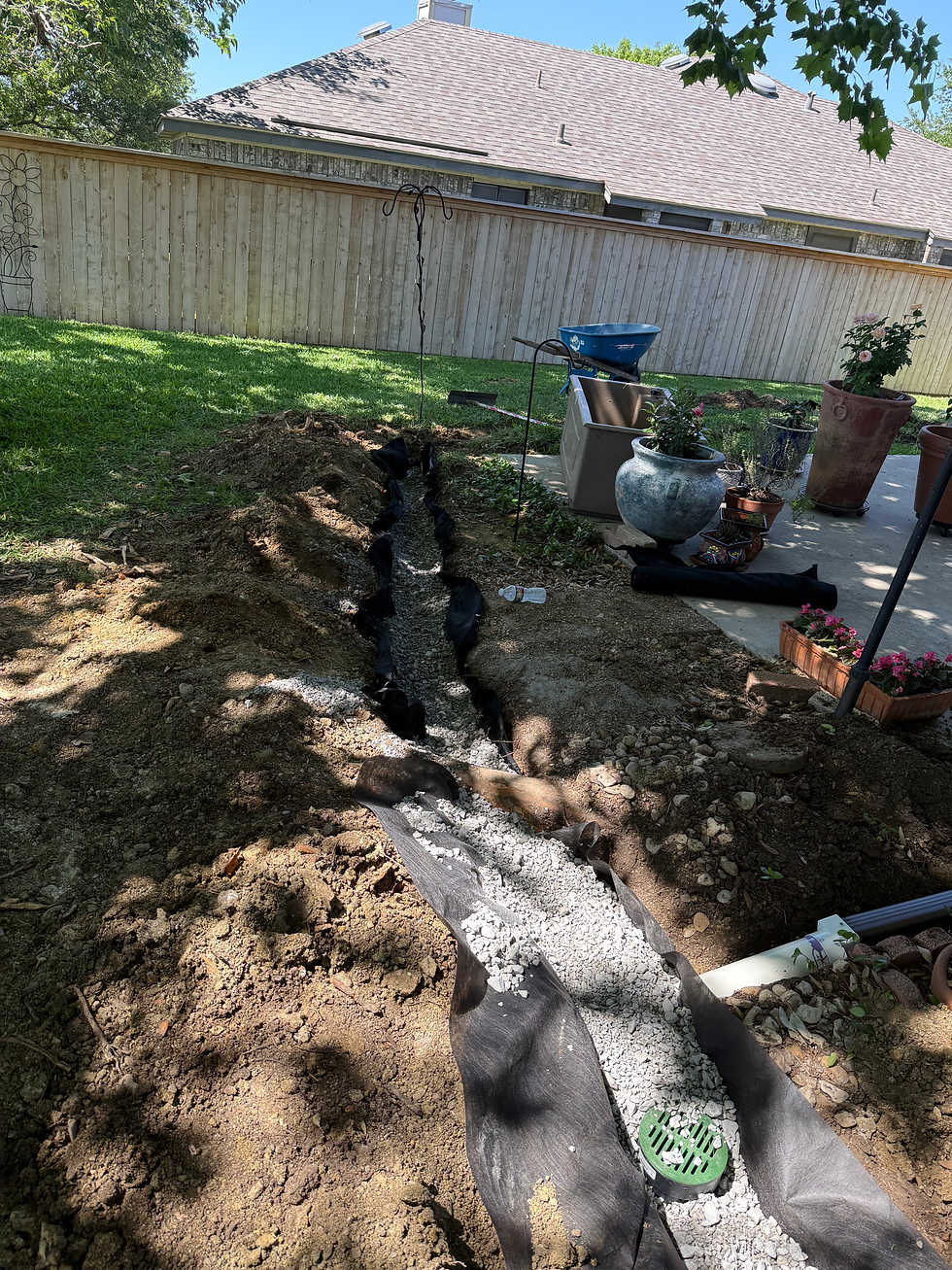
French drain. A sloped trench lined with filter fabric, filled with gravel and fitted with perforated pipe. Water seeps in from the surrounding soil and flows by gravity to an outlet.
Channel drain. A narrow trench with a removable grate on top, set into or beside concrete. Surface water drops through the grate and runs through solid pipe to an outlet.
Pump drain. A buried basin collects water from drains or low spots. When the water rises, a float switch turns on a pump that pushes it to the street or another safe discharge point.
When a French Drain Is the Right Fit
Choose a French drain when the problem is water in the soil, not on the surface:
The lawn stays soggy for days after rain.
Soil along the foundation stays wet.
Groundwater seeps out at the bottom of a slope.
Water builds up behind a wall; French drains are often built behind retaining walls to relieve that pressure.
For what moves the price, see our guide to French drain cost in Fort Worth.

When a Channel Drain Makes Sense
Choose a channel drain when water runs across a hard surface faster than it can soak in:
Rain sheets down the driveway into the garage.
The patio or pool deck holds puddles after every storm.
Water pours across a walkway toward the house.
Because concrete doesn't absorb water, a French drain beside it often can't keep up. A channel drain catches the water right where it lands.
When You Need a Pump Drain
A pump drain is the answer when there's simply nowhere lower to send the water:
No part of the lot sits lower than the problem area.
The street or neighboring yards are higher than your yard.
Water would have to travel uphill to reach an outlet.
Pump drains need power for the pump and occasional checks to keep the basin clear, but they solve problems no gravity system can.
Combining Systems for Problem Yards
Many yards need more than one type working together:
A channel drain at the garage and a French drain along the side yard, tied into one outlet.
Downspouts piped underground into a French drain.
A French drain that feeds a pump basin on a flat lot.
Regrading low spots first, so the drains have less work to do.
We design combined systems for yards across Fort Worth and nearby cities, including drainage services in Saginaw and Azle. Not sure what you're dealing with yet? Start with the signs of a yard drainage problem.
Frequently Asked Questions
What's the difference between a French drain and a channel drain?
A French drain sits below ground and collects water that has soaked into the soil, using gravel and perforated pipe. A channel drain sits at the surface and catches water running across hard surfaces through a grate.
Can a French drain work on a flat yard?
Only if there's somewhere lower to send the water. If there isn't, the French drain can feed a pump basin that pushes the water to an outlet.
Do pump drains need electricity?
Yes. The pump needs power, usually from a nearby outdoor outlet or its own circuit, so the location of power is part of planning a pump drain.
Which type of drain is the cheapest?
It depends on length, depth and the site. Many yards are fixed with a short run of the right drain rather than a large system, which is why a site assessment matters. Estimates are free, and there's never a trip charge.
Not sure which drain your yard needs? Bob's Landscape & Irrigation Solutions installs French drains, channel drains, pump drains and custom drainage systems across Fort Worth and nearby cities. Call 817-381-2128 or request a free estimate.
About the author: This guide was written by the team at Bob's Landscape & Irrigation Solutions. The company's founder started it in 2009 as a side business while teaching middle school engineering in Birdville ISD for 14 years, then took it full time. Today the team handles irrigation, drainage, retaining walls, dirt work and artificial turf across Fort Worth and surrounding cities.


Comments